The Shawnee Heights Fire District has a rich and long history. We’re proud of it and happy to share it with you.
From our small start in 1937 as the Topeka Fire Department, providing service outside the city limits for a fee, to the huge changes through the decades, our growth has been steady. Along the way, we’ve added more fire stations, more engines, trucks, and equipment, to better serve and protect our community. We’ve grown into protecting 190 square miles, with our district including Tecumseh, Topeka, Monmouth, and Williamsport Townships.


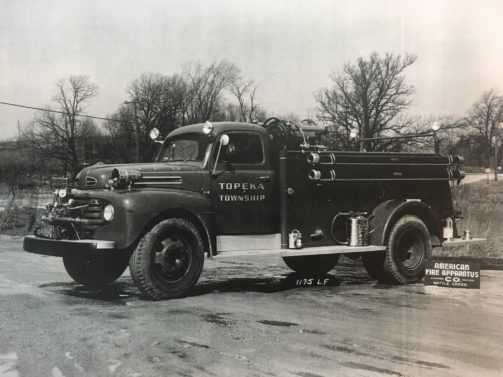

As the Highland Park community grew east of the city of Topeka, a water supply system designed for residential use and fire protection was built. Water mains were installed with fire hydrants placed so that every home was within 450 feet of a fire hydrant. The Topeka Fire Department provided fire suppression services to the areas outside the city limits, charging the surrounding townships a monthly fee for fire protection.
Topeka Fire Chief William Cawker notified townships surrounding the city that due to growth in the size of the city and the fire department’s responsibilities, the Topeka Fire Department would no longer respond to fires outside the city.
Townships that had traditionally been protected by the Topeka Fire Department would need to find a new fire protection provider.
At this time, Topeka Township was approximately 36 square miles, bounded on the west by Gage Boulevard and on the north by the City of Topeka. Most of the population of Topeka Township was centered around the Highland Park Community.
On January 8, 1939, Topeka Township began assessing a $2.00 fee per hydrant each month to be used by the township to provide fire protection. The Township Board met with State Legislators representing Topeka Township to request a bill allowing the township to form a fire department. Representatives Nickell and Brewster introduced an initial bill, House Bill 49,to allow the formation of township fire departments.
On February 24, 1939, the Kansas Legislature enacted a House Bill #138, related to the establishment of township fire departments. Governor Payne Ratner signed the bill and it was effective once it was published in the official state newspaper on February 23, 1939. This statute remains in force today, with amendments.
The day after the new state law went into effect, the Topeka Township drafted a resolution to form a fire department. The township held a special election to fund the construction of a fire station and purchase equipment for a fire department. On April 14, 1939, the election results were certified, providing funding to build a fire station and purchase the necessary fire equipment.
On April 17, 1939, the Topeka Township Board authorized the purchase of a “completed fire truck on International chassis, including centrifugal pump, 28-foot extension ladders, and 14-foot roof ladder, all conforming to the specifications submitted, from the American LaFrance Company, for the sum of $3,844. 89.”
H. Paul Little was hired as the first Fire Chief. On July 2, 1939 at 1:35 p.m., the Topeka Township Fire Department responded to its first alarm, extinguishing a wheat stubble field fire in the 2800 block of South Topeka Avenue (near where the National Guard Armory stands today). Volunteer firefighters were notified of fire alarms by a large siren mounted on the station roof. In the first year of operation, the department responded to 94 alarms; 38 of them were structure fires.
The department was very stable during the 1940s. During the 1940s radios were purchased to supplement the fire siren on top of the station. Upon until the radios were purchased, volunteer firefighters had to either respond to the station or call the station to find out the location of the fire. In 1949 H. Paul Little resigned as fire chief.
The 1950s saw many changes under the direction of the new fire chief, Harry S. Cox. The population of Topeka Township grew from 9,916 in 1940 to 13, 258 by 1950. Under Chief Cox, board was prompted to purchase new equipment. In 1950 the township purchased a new Ford pumper capable of pumping 500 gallons per minute. The staff was increased to 16 men in order to serve the growing population. In 1955 the township obtained another Ford pumper. This truck was equipped with a 500 gallon per minute pump and was designed to handle structure fires. In 1958 another Ford engine was obtained, and the original 1939 International fire engine was retired.
The additional of the additional fire engines created a need for more garage space. Therefore, additions were made to the fire station at 29th and California.
In 1957, a significant change occurred to the department when the City of Topeka annexed Highland Park. The 1960 census shows Topeka Township with a population of 3,949, a decrease of 9,309 from the 1950 census.
In 1959, contracts were signed to provide fire protection for neighboring Tecumseh and Williamsport Townships. During this period, the department also provided fire protection to other rural areas of Shawnee County, including Mission, Dover and Monmouth Townships.
By 1963, the Topeka Township Fire Department found itself responsible for a vast area of rural fire protection. In 1963 the Volunteer Emergency Service Team was formed. VEST was strictly a volunteer group that operated one piece of fire equipment and helped in the protection of southwestern Shawnee County. Vest and Topeka Township worked closely together, and many member of VEST eventually became members of the Topeka Township Fire Department.
One of VEST’s accomplishments was to establish a fire department for Dover Township. This relieved Topeka Township firefighters of some of it’s responsibility to the western part of Shawnee County.
In 1964, the Topeka Township Fire Department responded to 112 alarms, with reported damaged of $315,400.
In 1965, Chief Cox reported that the Topeka Township Fire Department was, “presently servicing the following townships by contact, Tecumseh, Monmouth, Williamsport and Mission. Presently we employ a Chief, Assistant Chief and 16 on-call. Two women who call men when needed with a total budget of $17,496.15.”
In 1966, Senate Bill #146 authorized the formation of the multi-township fire districts. On August 22, 1966 the Township Boards of Topeka and Tecumseh Townships agreed to create a joint fire district. Those signing for Topeka Township were Marvin Perkins, John F. Boley, and Lawrence Rusch. Signing for Tecumseh Township were Ray W. Johnson, George Kreipe, and Walter N. Nelson. The combined department was designated the Topeka-Tecumseh Fire District.
On January 4, 1968, the Governing Board of the Topeka-Tecumseh Fire District held a special meeting. Members present were: Lawrence Rusch, Chairman; Robert Engler, Treasurer; Marvin Perkins, Clerk; Theodore Hall, Clerk; and Walter Nelson, Trustee. Harry Cox continued to serve as the fire chief, with William Stone as assistant fire chief and Mrs. Harry Cox hired as a telephone operator. Volunteer firemen were $2.00 for the first 30 minutes and $0.50 or each 30 minute period thereafter. They were to receive $3.00 for each training drill attended.
The 1970s brought many changes. On August 17, 1971, Harry S. Cox died after serving as Fire Chief for 22 years. Chief Cox had proposed the installation of two fire stations to supplement the main station, but at the time of his death, this suggestion had not been implemented. Chief Cox’s concern for better fire protection stemmed from an awareness that insurance companies commonly required property to be within 10 miles of a fire station to be eligible for fire insurance. The area included in Topeka Township’s district extended as far as 23 miles from the single fire station at 29th and California.\
On September 1, 1971, the Board selected Mr. William “Bill” Nelson to serve as the new chief. Chief Nelson selected Jerry Benham to serve as assistant chief.
Due to the oil crisis and other considerations, mini-pumpers grew in popularity with fire departments. The Topeka-Tecumseh Fire Districts 1974 Dodge was believed to be the first of its kind in the state of Kansas. Pierce Manufacturing in Wisconsin built the fast attack/light rescue unit on a highly maneuverable one-ton, four-wheel drive chassis. It proved to be a useful piece of equipment and similar fast attack/light rescue vehicles served the department for the next 30 years.
In 1978, a water tanker truck was purchased. The truck was equipped with a 1500 gallon water tank and 500 gallon per minute pump. However, the larger, taller water tank led to problems as a lack of baffles in the water tank made the truck difficult to control due to the continually shifting water and high center of gravity. Ultimately, this truck was overturned and was rebuilt with a longer, lower water tank that included baffles.
Chief Nelson resigned on May 5, 1976. Upon his resignation, the Board promoted Jerry Benham to the position of Chief. They also appointed two assistant chief, Mike Harbour and Tony Bell. This meant the department would have three full-time employees to rotate working 24-hour shifts. However, later that year Jerry Benham stepped down as Fire Chief, and Mike Harbour was appointed as acting Chief. In January of 1977, Jim Fairbanks was selected by the board to be the new Fire Chief.
As of April 23, 1977, the Topeka-Tecumseh Fire Department consisted of 24 volunteers and three full-time employees. The response area reached to Wanamaker Road on the west, Osage County line to the south, the Douglas County line to the east, and the Kansas River/Topeka city limit to the north.
In November 1977, the Topeka-Tecumseh Fire District acquired a new radio base station and 15 voice pagers that were issued to firefighters. This greatly reduced response time for the department. Chief Fairbanks said, “The radio equipment is that start of a departmental expansion program planned for the next two years.” Plans also called for two more fire stations, a headquarters at 29th and Shawnee Heights to be built within the next year, and a substation at 53rd and Burlingame to be built within two years.
House Bill 2072 was passed in March 1977. This bill allowed Mission Township to increase their mill levy from one to four mills to purchase fire protection from the Topeka-Tecumseh Fire District. However, Mission Township residents were concerned about the long response of Topeka-Tecumseh fire trucks traveling from the east side to the west side of Topeka for fire alarms. As a result, the residents of Mission Township decided to organize their own fire protection. The developers of Lake Sherwood offered a site at 33rd and Urish Road, and residents purchased fire equipment. On January 8, 1978, the Mission Township Fire Department officially began providing its own fire protection.
Chief Fairbanks reported 65 fire calls in 1978. At least 13 of them were for illegal grass fires.
On January 1, 1979, the Topeka-Tecumseh Fire District occupied its new headquarters station at 2626 Shawnee Heights Road. The district added four new men to its roster that each station had one man scheduled on duty each shift. The new station had living quarters for a full-time dispatcher, as well as for a full-time firefighter along with an administrative office for the Fire Chief.
The department was now staffed 24 hours a day, seven days a week. The new employees hired effective January 1, 1979, were: Kerry Matthew, Thomas O’Sullivan, Stephen Campbell and Mitchell Cook. These four, along with Chief Fairbanks, Jerry Benham, and Jim Daugherty, made up the full-time staff of the Topeka-Tecumseh Fire District.
The addition of the new station meant the need for more equipment. A new engine, tanker, and mini-pumper were purchased. All three trucks were purchased from the Pierce Fire Equipment Company. The engine was a 1978 Ford with a 750-gallon tank and a 750-gallon-per-minute pump. The tanker was also on a 1978 Ford chassis with a 1500-gallon tank and a 500-gallon per minute pump. The mini-pumper was a 1978 Chevrolet with a 250-gallon tank and a 300-gallon-per-minute pump.
The next major change to occur was the board’s decision to relocate the station at 29th and California. The district’s response area had moved south and east since the original station had been built in 1939 and the City of Topeka grew. The new station on Shawnee Heights Road provided coverage for the east and southeast part of their territory. Now, the southwest part of the district needed more efficient coverage. A decision was made to purchase land on the southwest corner of 53rd and California as this site, northeast of Forbes Field, provided quick access to U.S. Highway 75 and Williamsport Township.
In January 1981, the Shawnee County Commission finalized the approval to rezone two, three-acre tracts of land at S.E. 53rd and California. The new station was expected to cost approximately $180,000. To finance the new station at 53rd and California, an auction was held on June 3, 1981, to sell the original fire station at 29th and California.
The station at 53rd and California was dedicated in 1981.
With the addition of this station, most of the structures under the district’s protection were within five miles of a station. However, the department also served Monmouth and Williamsport Townships, and some of those townships remained more than 22 miles from the nearest station.
In late 1981, Jim Fairbanks stepped down after serving nearly 5 years as fire chief. Larrow Swallow was installed as fire chief in February of 1982. Under his direction, the full-time officers were assigned different duties for the district. Two officers oversaw vehicle maintenance, one was responsible for training and the others were charged with handling fire prevention and education.
On February 28, 1982, the Topeka-Tecumseh Fire District family lost a brother firefighter in the line of Duty. Firefighter William E. Duncan suffered a fatal abdominal injury after falling on ice at a fire scene. It was determined that during the fall, his self-contained breathing apparatus (SCBA) caused a ruptured abdominal aneurysm. Firefighter Duncan’s sacrifice is remembered on the Kansas and National Fallen Firefighters Memorials.
As part of a national trend, the Topeka-Tecumseh Fire District began to explore ways in which they could establish and fund an emergency medical fire responder program. Historically, fireighters had only responded to fires and the occasional car accident in which victims were trapped. In 1984, the District asked voters to approve the creation and funding of an emergency medical program. However, the referndum failed to pass 2,224 votes to 1,915 votes.
911 came to Shawnee County in 1985, however rural fire departments continued to employ their own dispatchers and radio systems. Calls to the 911 center were transferred to the appropriate fire department.
In March of 1986, Topeka Township had 42% of its assessed valuation taken by the City of Topeka through annexation. Not only did this decrease the territory served by the fire district, but it decreased the tax base.
In May 1989, Lou Alexander celebrated 50 years with the fire district. He watched the department grow from one truck and 12 firefighters to more than 30 firefighters and 10 trucks. Alexander served a volunteer firegfighter his whole career, which the exception of a term as assistant fire chief from 1940-1942. Alexander remembered that when he started with the department the primary calls were for grass and structure fires. He noted many things changed during his years of service including the tope of fire protection needed and the typed of equipment used to fight fires.
The first responder issue lay dormant for several years until a May 1989 accident spurred Cindy Haynes to address the fire board and request the establishment of a first-responder program in the Topeka-Tecumseh Fire District. Her determination and publicity campaign led to a petition drive and show of support for the program at the September board meeting. A committee began work to determine the cost to provider first-responder emergency medical services. In addition, the board passed a resolution establishing a new property tax to pay for first-responder services starting in 1991. The resolution was published in the Capital-Journal for three consecutive weeks before it became effective, then another 60 days was required to allow protestros to obtain signatures to force a special election.
On November 13, 1989, the Topeka-Tecumseh Fire District became the last fire department in Shawnee County to begin providing first-responder emergency medical services.
The Topeka-Tecumseh Fire District planned to celebrate its 50th anniversary on Saturday and Sunday, September 2-3, 1989, with station tours, a water barrel fight, and equipment demonstations. Just like the inital open houe on Septemeber 3, 1939, which was interrupted by a hale bale fire, three fire calls interrupted the 50th anniversary celebration.
A task force was appointed in 1993 by the Topeka City Council and the Shawnee County Commission to establish a single county-run department to answer 911 emergency calls and provide public safety dispatch services. The task force proposed a county department operate a 911 dispatch service to replace the city-run Topeka Emergency Communications Center, as well as the dispatching centers operated by the sheriff’s department and other police and fire departments across the county. The task force proposed a four-person management board consisting of the Topeka Police Chief, Topeka Fire Chief, Shawnee County sheriff, and one of the rural county fire chiefs. As part of the transition, all emergency agencies in the county would receive standardized radio equipment to increase interoperability during emergencies. Topeka-Tecumseh Fire Chief Larry Swallow was selected to serve on the new emergency communication management board.
In 1997, an era passed as dispatchers and their families were no longer houses in district fire stations. Shawnee County assumed operation of all emergency communications and combined five law enforcement agencies and eight fire agencies into one consolidated dispatch center. All radio services were consolidated onto a county-wide trunked 800-MHz radio system. The county also designated a new fire station and fire apparatus numbering system, which led the station on Shawnee Heights Road to be renamed Station 21 and the station at 53rd and California to renamed Station 23. All fire trucks operated by the fire district had numbers in the 20’s (e.g. Engine 21) and all individual firefighters were given radio number in the 200 series.
The Topeka-Tecumseh Fire District spent an additional $22,000 so that all firefighters could be issued and carry an 800-MHz portable radio. On April 11, 1998, one of these additional radios, carried by an off-duty firefighter, played a major role in notifying the department of a structure fire with occupants inside. Within minutes, three fire trucks were at the scene and the family was safely evacuated.
In 1999, the Shawnee County Commission adopted Home Rule Resolution No. HR-99-3 requiring the public to obtain written permits prior to initiating open burning. The resolution created rules for open burning, provided for the issuance of burning permits by county fire departments, and set penalties for violations of the open burning resolution. Each year, the fire district issues several thousand open burning and investigates complaints of illegal burning.